
How many Google reviews should a fitness studio get each month?
A practical Google review cadence for fitness studios, including when to aim higher, how strong your rating should be, and what to do about negative reviews.
Short answer
An active fitness studio should get at least one new, authentic Google review every month. That should be the minimum, with higher goals for studios with more customers, tougher competition, or stronger review expectations in their niche. Aim to keep your rating comfortably above 4.5, and address negative reviews when they appear.
On this page
An active studio should not let its newest review get months old while customers are coming through the doors every week.
BrightLocal’s 2026 consumer survey gives a useful benchmark for how much freshness and rating quality matter to customers:
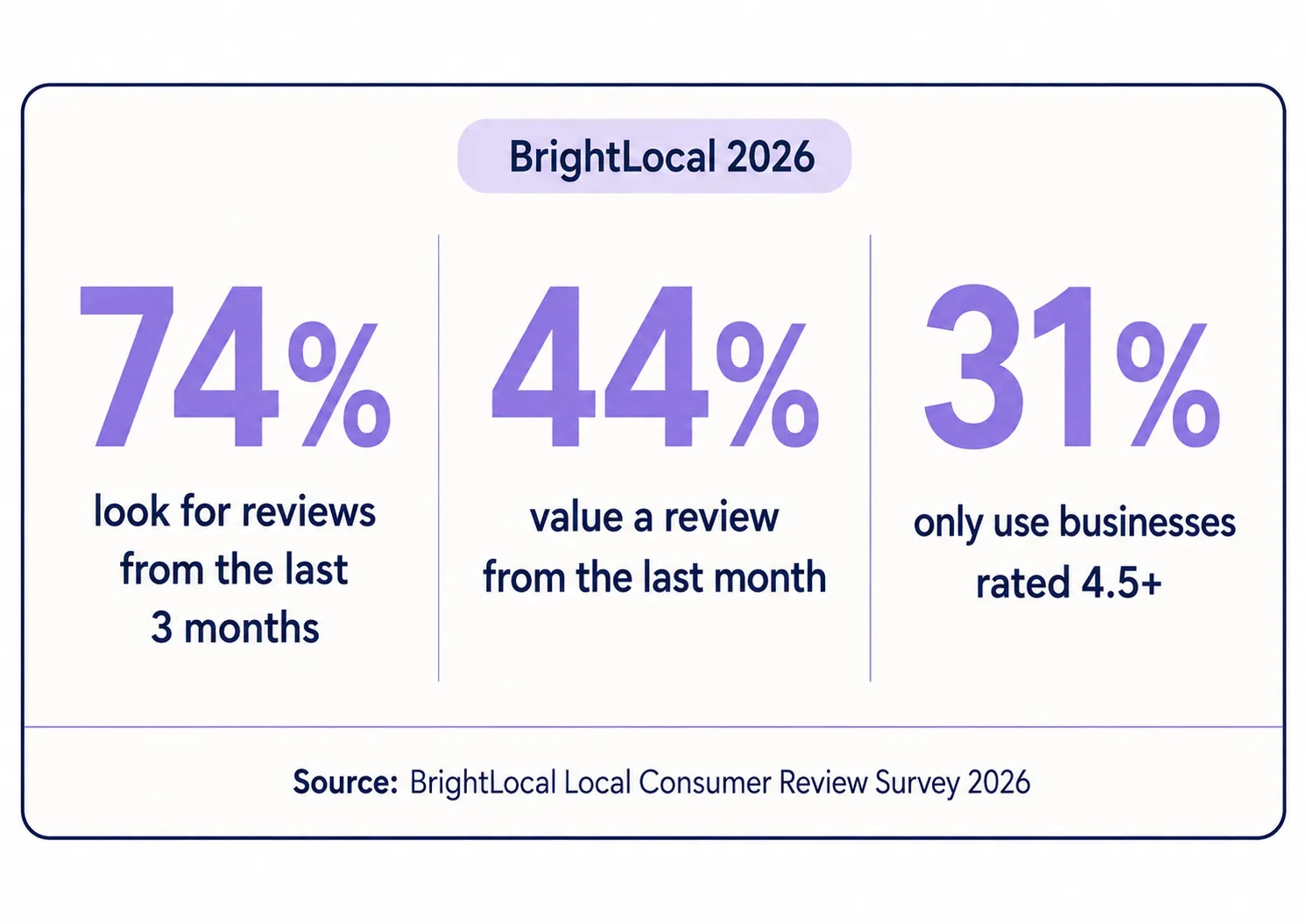
Google also says that more reviews and positive ratings can help a business’s local ranking. It does not set a monthly review target. One per month is a practical minimum because it prevents long dry spells and keeps the studio’s total review count growing.
For a small Pilates or yoga studio, one or two new reviews each month may be enough to keep its review history current and growing. A busy multi-instructor studio welcoming hundreds of member visits each month should not stop asking just because it received one review early in the month.
When one review per month is not enough
Raise the goal when one review a month no longer matches the business you run.
Three things matter most:
- Customer volume: a busier studio has more real customer experiences and more natural opportunities to ask for feedback.
- Nearby competition: if comparable studios are receiving several recent reviews each month while yours gets one occasionally, your target should be higher.
- Your niche: if customers choosing among studios like yours routinely see strong, current review histories, sparse recent feedback can make the studio look less established or current.
Use a quick reality check. Look at a few genuinely comparable nearby studios and the dates on their recent reviews. If they are consistently adding several reviews each month and you are adding one, raise your target. You do not need a spreadsheet or formal competitor score.
Reviews are only one part of local visibility. If the larger problem is that the studio is difficult to find on Google, start with why a fitness studio may not be showing on Google Maps. If you are unsure whether reviews deserve priority over another marketing problem, use the gym-marketing guide to choose what to address first.
Keep your rating comfortably above 4.5
Cadence cannot compensate for a weak rating.
BrightLocal found that 31% of consumers will only use businesses rated 4.5 or higher, while 68% require at least a 4.0 rating. For an active studio, treat 4.5 as a score to stay above rather than a target to settle at.
A perfect 5.0 is not required. The goal is a strong rating built from genuine customer experiences. Google allows businesses to ask customers for honest reviews, but prohibits incentives, pressure for a particular rating, and selectively asking only customers expected to leave positive feedback.
If the rating starts slipping, read the recent negative reviews for repeated problems. If several customers mention the same class experience, cleanliness issue, cancellation frustration, or front-desk problem, fix the underlying issue and keep asking real customers for honest feedback.
What to do about negative reviews
First decide whether the review is legitimate.
- If the complaint is legitimate: reply calmly, acknowledge what is true, and address the underlying problem. Google notifies the reviewer when you reply, and the reviewer can later update the review. If you resolve the issue, the customer may choose to update the review. That decision belongs to the customer.
- If the review is illegitimate: reviews that are fake, off-topic, written by someone with a conflict of interest, or otherwise violate Google’s policies can be reported to Google for review. A negative opinion does not qualify for removal simply because the studio disagrees with it.
Do not offer a refund, discount, or other incentive in exchange for changing or removing a negative review. Resolve legitimate complaints because the customer experience needs fixing, then let the customer decide whether to update the review.
Make review requests a normal habit
Do not wait until the end of the month to remember reviews. Build the request into moments that already happen at the studio.
Natural opportunities include:
- after someone completes an intro offer or first class pack;
- after a meaningful member milestone;
- after a customer gives an unsolicited compliment;
- after a successful event, workshop, or program.
Google lets businesses create a direct review link or QR code. Use it in a normal follow-up email, message, receipt, or at the studio so leaving a review is easy.
Ask for an honest Google review. Do not ask for five stars, offer a reward, or screen customers so that only happy ones receive the request.
If an active studio reaches the end of a month without a new authentic review, make review requests more consistent. If the studio reaches the monthly minimum early, keep asking at natural moments instead of stopping for the rest of the month.
Sources
A clearer next step
Know what to improve first, not just what changed.
StudioCues monitors the public signals around your studio and turns them into focused, evidence-backed priorities.